
January is Cervical Cancer Awareness Month

By Jess Donovan, MPH (MN Community Measurement) & Matt Flory (American Cancer Society)

Click to view infographic
As we kick off MNCM’s 2026 infographic series, we’re putting the spotlight on cervical cancer. Cervical cancer, which is primarily caused by persistent infection with the human papillomavirus (HPV), was once the most common cause of cancer death in American women.1,2,3 Fortunately, since the development of the HPV vaccine and screening, the rate of death from cervical cancer has dropped more than half since the mid-1970s.2 In fact, cervical cancer is the 22nd cause of new cancer cases, accounting for approximately 0.7% of all new cancer cases.1 Compared to breast cancer, which is the number one cause of new cancer cases (15.5% of new cases), cervical cancer is considered rare.1 Prevention through vaccination and screening is key.


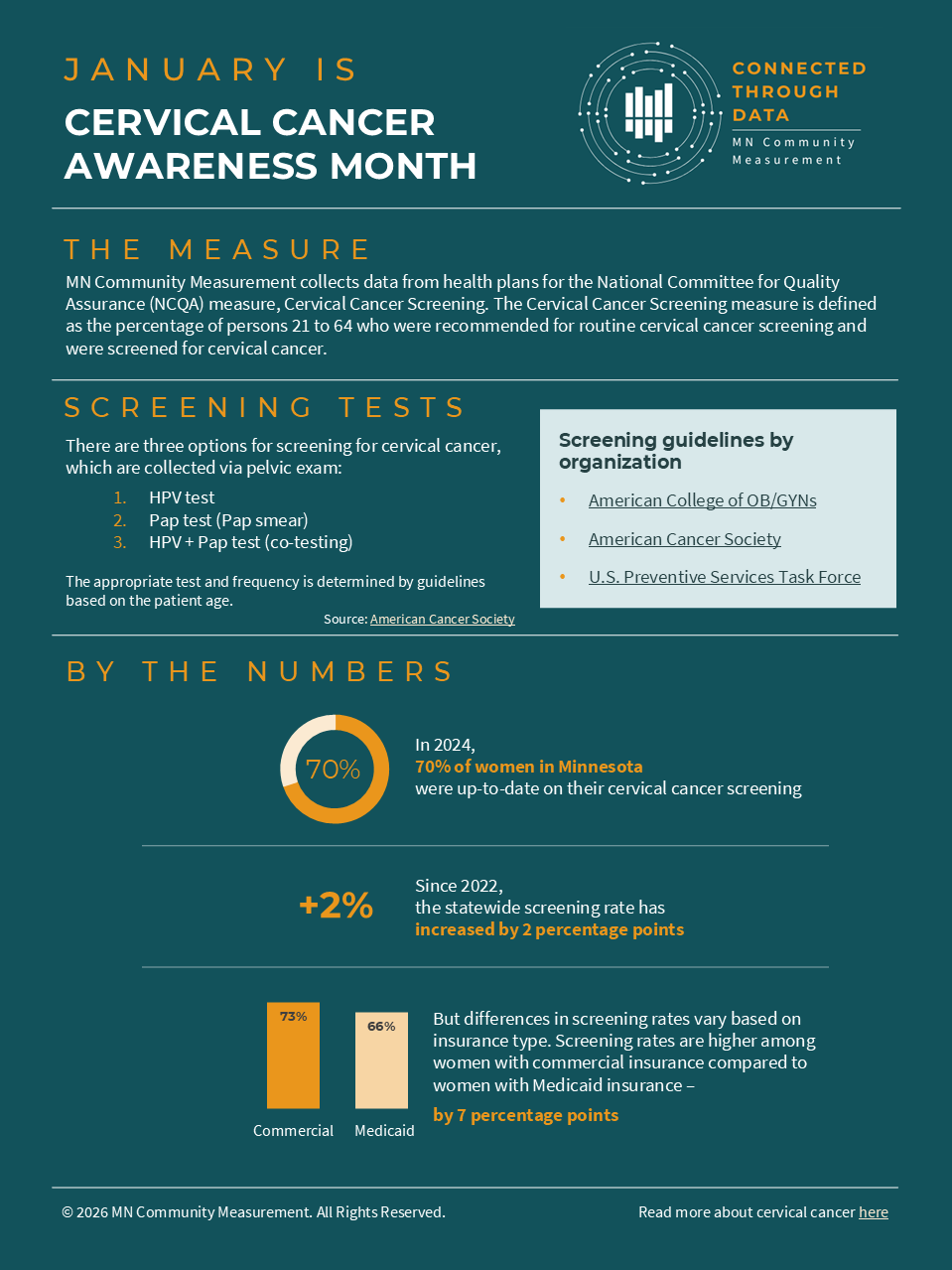
Cervical Cancer Screening Tests

Three methods are available for cervical cancer screening, and the most suitable choice depends on current guidelines and the individual's age:4

1.     High-risk HPV test (hrHPV)

2.     Pap smear (cytology)

3.     HPV + pap smear (co-testing)

Disparities in Cervical Cancer

Despite the advancements made in the prevention and vaccination space, there remains differences in both diagnosis and death rates, particularly by age and race/ethnicity group.


Age

Women between the ages of 35 to 64 are the most frequent age group diagnosed with cervical cancer, with the median age at diagnosis being 50.1,2 However, women in the 55-64 age group have the highest percentage of cervical cancer deaths, with the median age at death being 60.1


Race/Ethnicity

In Minnesota, women of color are more likely to be diagnosed with late-stage cervical cancer, making it difficult to treat.3   Women who are Indigenous/Native are four times more likely to be diagnosed with late-stage cervical cancer compared to white, non-Hispanic women.3 At the national level, Indigenous/Native and Black women have the highest rate of death from cervical cancer compared to other race groups.1,2


Cervical Cancer Screening Measure

The Cervical Cancer Screening measure is stewarded by the National Committee for Quality Assurance (NCQA) and is reported to MN Community Measurement by health plans. The measure is defined as:


The percentage of women who were screened for cervical cancer using any of the following criteria:

  • Women 21-64 years of age who had cervical cytology performed within the last 3 years.
  • Women 30-64 of age who had cervical hrHPV testing performed within the last five years.
  • Women 30-64 years of age who had cervical cytology/hrHPV co-testing within the last five years.


What MNCM Data Show

In 2024, approximately 70% of women in Minnesota were up-to-date on their cervical cancer screening. Since 2022, the statewide screening rate has increased by two percentage points. However, differences in screening rates varied by insurance type, with 73% of women with commercial insurance and 66% of women with Medicaid being up-to-date with their screening.


Why This Matters

The significant decline in the number of new cervical cancer highlights the importance of routine screening and vaccination for cancer prevention. The HPV vaccine can help prevent 90% of cervical cancers, and recent data shows a 79% decrease in cervical precancers among women aged 20-24, which is the group that is most likely to have been vaccinated against HPV.5 As a result, the Minnesota Department of Health and the American Academy of Pediatrics recommends that all adolescents (females and males) receive the HPV vaccine series between the ages of 9 and 12 years of age. In addition to vaccination, keeping up-to-date on cervical cancer screenings as recommended by health care providers can help catch cancer early and make it easier to treat.


References

  1. National Cancer Institute. Cancer Stat Facts: Cervical Cancer. Surveillance, Epidemiology, and End Results Program. Retrieved from https://seer.cancer.gov/statfacts/html/cervix.html
  2. American Cancer Society (2026). Key Statistics for Cervical Cancer. Retrieved from https://www.cancer.org/cancer/types/cervical-cancer/about/key-statistics.html
  3. Minnesota Department of Health (2025). Cervical Cancer in Minnesota. Fact Sheet. Retrieved from https://www.health.state.mn.us/data/mcrs/docs/cervicalfs.pdf
  4. American Cancer Society (2025). The American Cancer Society Guideline for Cervical Cancer Screening. Retrieved from https://www.cancer.org/cancer/types/cervical-cancer/detection-diagnosis-staging/cervical-cancer-screening-guidelines.html
  5. Gargano JW, Stefanos R, Dahl RM, et al. Trends in Cervical Precancers Identified Through Population-Based Surveillance — Human Papillomavirus Vaccine Impact Monitoring Project, Five Sites, United States, 2008–2022. MMWR Morb Mortal Wkly Rep 2025;74:96–101. DOI: http://dx.doi.org/10.15585/mmwr.mm7406a4
  6. Minnesota Department of Health (2026). Vaccines for Infants, Children, and Adolescents. Retrieved from https://www.health.state.mn.us/people/immunize/basics/kids.html#schedule


Recent Posts

By Liz Cinqueonce, MBA October 30, 2025
By Liz Cinqueonce, MBAPresident & CEO of MNCM At MN Community Measurement (MNCM), we believe that the most meaningful progress in health care comes when the community is at the center—when those closest to the work and most affected by outcomes help shape the path forward. Building on this foundation, we are making interoperability a… The post Community at the Helm: Interoperability as a Priority for Minnesota’s Health Data appeared first on MN Community Measurement.

By Jess Donovan, MPH, BSN October 21, 2025
This October marks the 40th anniversary of Breast Cancer Awareness Month. According to the American Cancer Society, about 1 in 8 women will be diagnosed with invasive breast cancer in their lifetime. Fortunately, however, early detection through screening and advances in treatment have decreased mortality by 44% since 1989. Screening can catch cancer early, when it is… The post Empowered by Data: Uncovering Screening Disparities and Reducing Breast Cancer Risk appeared first on MN Community Measurement.

By Jess Donovan, MPH, BSN September 30, 2025
September is Sexual Health Awareness Month. As we close out September, we’re highlighting two of the measures we report on – Cervical Cancer Screening and Chlamydia Screening in Women.   Cervical cancer, once one of the most common cancers affecting women in the United States, has significantly decreased since the 1970s. The reason for the decline… The post Empowered by Data: Spotlight on Screening for Sexual Health appeared first on MN Community Measurement.

By Liz Cinqueonce, MBA September 25, 2025
"It feels like.." The post Elevating Local Voices: Insights from MNCM’s Regional Community Conversations appeared first on MN Community Measurement.
By Jess Donovan, MPH, BSN August 20, 2025
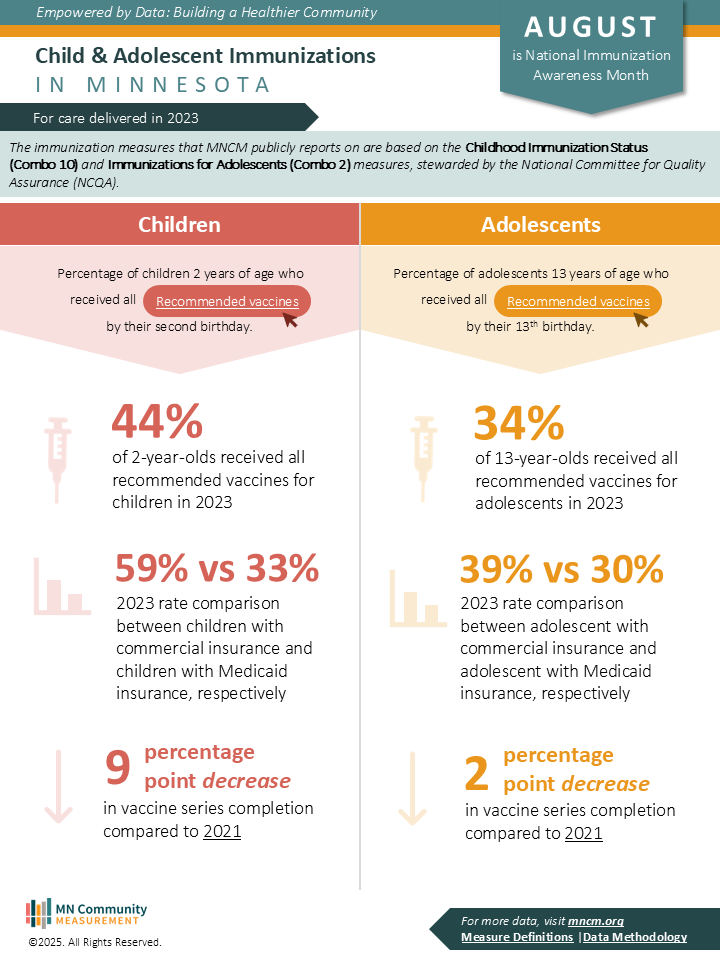
By Jess Donovan, MPH, Clinical Measurement Analyst, MN Community Measurement; and Steven Inman, MD, Medical Director, Children’s Health Network August is National Immunization Awareness Month. Vaccines are a safe and effective way to protect both individuals and communities from serious and preventable illnesses like measles, tetanus, diphtheria, and influenza. However, the health of the community… The post Empowered by Data: Uncovering Immunization Gaps in Children and Adolescents appeared first on MN Community Measurement.
Recent Comments

Archives

Categories