



Collaboration Blog | March is Colorectal Cancer Awareness Month

March 11, 2020

By Matt Flory (American Cancer Society) and Jessica Donovan (MN Community Measurement)

In Minnesota, colorectal cancer is the third most common cancer and the second leading cause of cancer death. Routine screening can detect cancer earlier, even before symptoms occur, which makes it easier to treat. In some cases, precancerous polyps detected during screening can be removed and most patients do not go on to develop colorectal cancer.

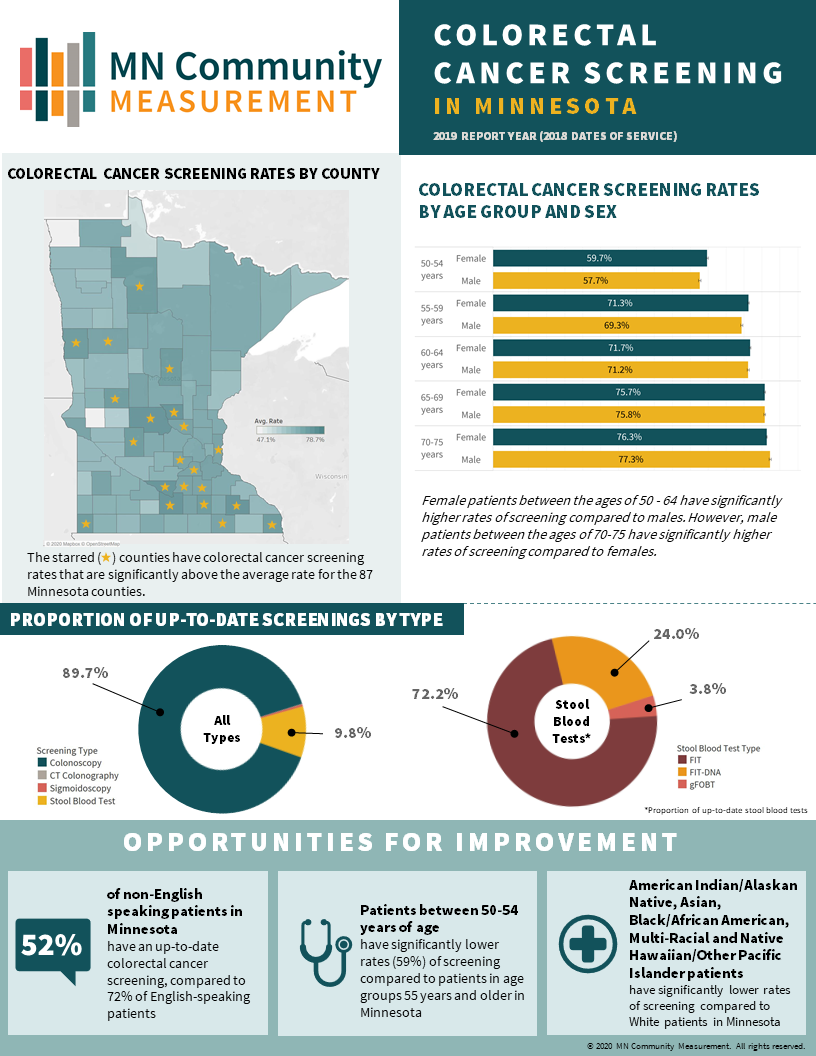
MNCM Infographic:
2019 Colorectal Cancer Screening
in Minnesota

MN Community Measurement (MNCM) collects and reports colorectal cancer screening data for over 700 clinics across Minnesota. The following screening tests are captured in the Colorectal Cancer Screening measure: colonoscopies, sigmoidoscopies, CT colonographies and stool blood tests. In the 2019 report year (2018 dates of service), the majority of the screening tests used in Minnesota were colonoscopies (89.7%), while stool blood tests were the second most common (9.8%). Of the stool blood tests used, the Fecal Immunochemical Test, or FIT, was the most common. With the variety of screening tests available, including some that can be used at home, providers can work with patients to select the test that is most appropriate for the patient.

For over a decade, Minnesota stakeholders have beenpartnering to increase state and local screening rates with a goal of reaching 80% in every community. InMNCM’s most recent HealthCare Quality Report , there are over 50 clinics that have already met orsurpassed this goal. An analysis of population screening data by county, showsthat 21 counties across Minnesota surpass the overall average of 71% among the87 counties. However, there remains significant variation across the state,indicating opportunities for improvement. Data for county level colorectalcancer incidence and mortality is available on the MinnesotaDepartment of Health’s website.

Additionally, there remains opportunities for improvement within certain demographics:

  • Both men and women between the ages of 50 – 54 have significantly lower rates of screening compared to older age groups.
  • Men between the ages of 50 – 64 have significantly lower rates of screening compared to women of the same age range. However, men between the ages of 70 – 75 have significantly higher rates of screening compared to women of the same age range.
  • Non-English-speaking patients have significantly lower rates of screening compared to English-speaking patients.
  • Populations of color have significantly lower rates of screening compared to White patients.

The National Colorectal Cancer Roundtable has published a number of materials for providers interested in increasing their colorectal cancer screening rates, including a Clinician’s Reference and a Messaging Guidebook. For additional questions about available resources, please contact Matt Flory ( matt.flory@cancer.org ) at the American Cancer Society.

At the American Cancer Society, we’re on a mission to free the world from cancer. Until we do, we’ll be funding and conducting research, sharing expert information, supporting patients, and spreading the word about prevention. All so you can live longer — and better.

MN Community Measurement (MNCM) is a nonprofit, multi-stakeholder collaborative organization that empowers the community with data and information to drive improvement in health care cost and quality. Collaborators include physicians, hospitals and health systems, health plans, employers, consumers, and state government. MNCM specializes in developing, collecting, analyzing, and publicly reporting information on health care quality, cost, and patient experience. Additional reports published by MNCM can be found on  mncm.org .


Posted in Blog

Recent Posts

By Jessica Donovan April 29, 2026
MN Community Measurement (MNCM) has released two new reports highlighting the state’s health care performance: Health Care in Minnesota: Summary Report on Quality, Disparities, and Cost and Health Care in Minnesota: Health Care Quality Leaders . Together, these reports provide a comprehensive analysis of 2024 data, examining trends in health care quality, disparities, and costs, while also recognizing medical group quality leaders and those demonstrating meaningful improvement. These reports, based on data submitted to MNCM in 2025 and reflecting care delivered in 2024, work in tandem with MNCM’s Performance Hub —an interactive platform providing statewide analyses of health care quality and cost measures. Collectively, these tools equip community partners, including medical groups, payers, policymakers, public health agencies, researchers, and community-based organizations, with actionable insights to drive improvements in care and advance health equity across Minnesota. Report highlights include: Health Care Quality Significant gaps remain in asthma control, with thousands of patients needing improved care to meet statewide benchmarks. Colorectal cancer screening rates for the newly eligible 45-49 age group continues to improve. While the 2024 rate for all age groups has significantly increased compared to 2023, it remains significantly lower than 2021. Childhood immunization continues to show a decrease in statewide rate from year to year. This measure has not shown improvement in rates following the COVID-19 pandemic. There were modest improvements in breast cancer screening, cervical cancer screening, controlling high blood pressure, diabetes eye exams, and immunizations for adolescents. Health Care Disparities Black, Indigenous, Multi-Race, and Hispanic/Latinx patients experienced the most disparities across multiple measures, particularly in Colorectal Cancer Screening. Patients speaking Somali and Spanish, as well as those from Laos, Mexico, and Somalia, had lower rates of preventive care and chronic disease management compared to statewide averages. Cost and Utilization The total cost of care increased by 7.3% in 2024, primarily driven by an 8.9% rise in pharmacy costs and an 8.3% rise in professional fees. All categories of medical services saw increased use, except for inpatient admissions. Women aged 36-64 had the highest number of claims, while men aged 18-35 had the lowest number of claims. Quality Leaders In 2024, 31 medical groups were recognized as quality leaders across the measures reported by medical groups. In 2024, 58 medical groups were recognized as quality leaders across the measures reported by payers. 

By Elizabeth Cinqueonce March 5, 2026
Aligning for Impact: Minnesota's Health Data Evolution A 2026 Leadership Series from the MNCM Board Chair & President
By Jessica Donovan January 21, 2026
CONNECTED THROUGH DATA: Uncovering Disparities in Cervical Cancer
By Jess Donovan, MPH, BSN October 21, 2025
This October marks the 40th anniversary of Breast Cancer Awareness Month. According to the American Cancer Society, about 1 in 8 women will be diagnosed with invasive breast cancer in their lifetime. Fortunately, however, early detection through screening and advances in treatment have decreased mortality by 44% since 1989. Screening can catch cancer early, when it is… The post Empowered by Data: Uncovering Screening Disparities and Reducing Breast Cancer Risk appeared first on MN Community Measurement.
By Jess Donovan, MPH, BSN September 30, 2025
September is Sexual Health Awareness Month. As we close out September, we’re highlighting two of the measures we report on – Cervical Cancer Screening and Chlamydia Screening in Women.   Cervical cancer, once one of the most common cancers affecting women in the United States, has significantly decreased since the 1970s. The reason for the decline… The post Empowered by Data: Spotlight on Screening for Sexual Health appeared first on MN Community Measurement.

Recent Comments

Archives

Categories