
Rates of Follow-up After a Diagnosis of Depression Show Substantial Room for Improvement

September 22, 2020

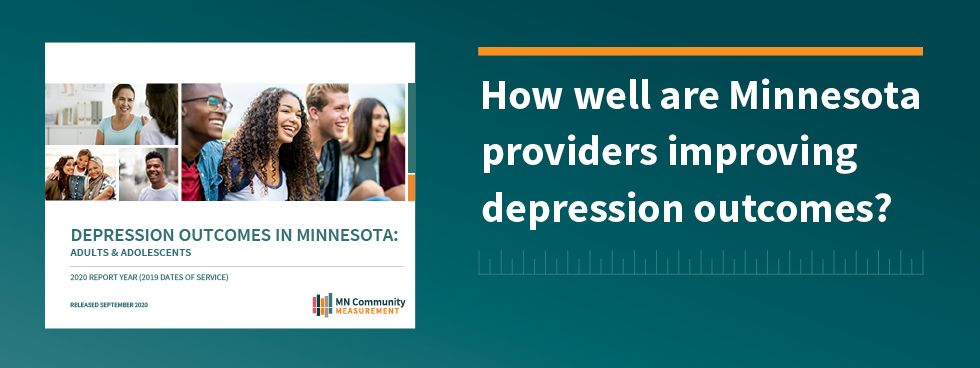
MNCM releases its Depression Care in Minnesota: Adults and Adolescents report

MN Community Measurement, an independent nonprofit organization that empowers health care decision makers with meaningful data to drive improvement, has released a new report on outcomes for treatment of depression in Minnesota.

The Depression Care in Minnesota: Adults and Adolescents  report includes new measures of depression outcomes for adolescents, as well as updated data for adults. An appendix to the report includes detailed quality information for 112 medical groups and 734 clinics in Minnesota and neighboring states.

The data in the report were collected in early 2020, and reflect care received in 2019. Measures of depression care include how often patients who are diagnosed with depression receive follow-up care, the percentage of patients who show improvement (response to treatment), and the percentage of patients whose depression is in remission. Because of technical changes to the measure, the depression outcomes measures included in this report are not comparable to prior years.

Depression is a very common condition that has historically been underdiagnosed and undertreated. Nationally, about 15.7 percent of adolescents aged 12 to 17 and 7.8 percent of adults had a major depressive episode in 2019.

“Because depression has such a big impact on people’s lives, it’s important to understand how well our health care system is doing at helping people get better,” said Julie Sonier, MN Community Measurement President and CEO. “We still see wide variation in outcomes, and substantial room for overall improvement. That’s particularly important now, as we know many more people are experiencing symptoms of depression in today’s extraordinary circumstances.”

Recent federal survey data suggest that as many as 25 percent of American adults were experiencing symptoms of depression in mid-2020, compared to about 7 percent in 2019.

Here are some report highlights:

• For both adolescents and adults, rates of follow-up after a diagnosis of depression show substantial room for improvement. For example, only 48.5 percent of adults and 43.4 percent of adolescents were re-assessed after six months.

• Average rates of depression response and remission are low but some health care providers achieve results that are well above expected rates after accounting for differences in the characteristics of their patient populations. As an example, 19.4 percent of adults and 15.5 percent of adolescents showed improvement (response) after six months. Medical groups with the highest risk-adjusted performance on this measure achieved rates that were 1.78 times expected results for adults (Westfields Hospital and Clinic) and 1.84 times the expected rate for adolescents (Mankato Clinic, Ltd.).

• Use of screening tools and standardized tools for diagnosing depression is high. Nearly 90 percent of adolescents who had well-child visits in 2019 were screened for mental health and/or depression, and nearly 80 percent of adults and adolescents who were diagnosed with depression completed a standardized tool as part of their diagnosis.

Importance of Measurement

Measuring and reporting on health care quality is important because it helps consumers know how care varies across providers, and it helps providers to understand how their results compare to others and where their biggest improvement opportunities are. Measuring and reporting also help health plans and other purchasers better understand and improve value for money that is spent on health care.

“Minnesota is really unique in the nation in the capabilities we’ve built to measure and report on health care outcomes,” said Sonier. “The measures we track are important tools for getting better health outcomes. There continues to be wide variation in outcomes for depression care, which shows that there is still a lot of opportunity for improvement.”

Depression Care Resources

The National Alliance on Mental Illness in Minnesota has various resources for mental health support. Visit https://namimn.org/support/resources/ to learn more.

For suicide prevention, awareness and support, visit https://namimn.org/education-public-awareness/suicide-prevention/ or call 1-800-273-8255.


Posted in Press Release

Recent Posts

By Elizabeth Cinqueonce May 13, 2026
MN Community Measurement Recognizes Innovation and Collaboration in Clinical Quality Measurement
By Jessica Donovan April 29, 2026
MN Community Measurement (MNCM) has released two new reports highlighting the state’s health care performance: Health Care in Minnesota: Summary Report on Quality, Disparities, and Cost and Health Care in Minnesota: Health Care Quality Leaders . Together, these reports provide a comprehensive analysis of 2024 data, examining trends in health care quality, disparities, and costs, while also recognizing medical group quality leaders and those demonstrating meaningful improvement. These reports, based on data submitted to MNCM in 2025 and reflecting care delivered in 2024, work in tandem with MNCM’s Performance Hub —an interactive platform providing statewide analyses of health care quality and cost measures. Collectively, these tools equip community partners, including medical groups, payers, policymakers, public health agencies, researchers, and community-based organizations, with actionable insights to drive improvements in care and advance health equity across Minnesota. Report highlights include: Health Care Quality Significant gaps remain in asthma control, with thousands of patients needing improved care to meet statewide benchmarks. Colorectal cancer screening rates for the newly eligible 45-49 age group continues to improve. While the 2024 rate for all age groups has significantly increased compared to 2023, it remains significantly lower than 2021. Childhood immunization continues to show a decrease in statewide rate from year to year. This measure has not shown improvement in rates following the COVID-19 pandemic. There were modest improvements in breast cancer screening, cervical cancer screening, controlling high blood pressure, diabetes eye exams, and immunizations for adolescents. Health Care Disparities Black, Indigenous, Multi-Race, and Hispanic/Latinx patients experienced the most disparities across multiple measures, particularly in Colorectal Cancer Screening. Patients speaking Somali and Spanish, as well as those from Laos, Mexico, and Somalia, had lower rates of preventive care and chronic disease management compared to statewide averages. Cost and Utilization The total cost of care increased by 7.3% in 2024, primarily driven by an 8.9% rise in pharmacy costs and an 8.3% rise in professional fees. All categories of medical services saw increased use, except for inpatient admissions. Women aged 36-64 had the highest number of claims, while men aged 18-35 had the lowest number of claims. Quality Leaders In 2024, 31 medical groups were recognized as quality leaders across the measures reported by medical groups. In 2024, 58 medical groups were recognized as quality leaders across the measures reported by payers. 

By Elizabeth Cinqueonce March 5, 2026
Aligning for Impact: Minnesota's Health Data Evolution A 2026 Leadership Series from the MNCM Board Chair & President
By Jessica Donovan January 21, 2026
CONNECTED THROUGH DATA: Uncovering Disparities in Cervical Cancer
By Jess Donovan, MPH, BSN October 21, 2025
This October marks the 40th anniversary of Breast Cancer Awareness Month. According to the American Cancer Society, about 1 in 8 women will be diagnosed with invasive breast cancer in their lifetime. Fortunately, however, early detection through screening and advances in treatment have decreased mortality by 44% since 1989. Screening can catch cancer early, when it is… The post Empowered by Data: Uncovering Screening Disparities and Reducing Breast Cancer Risk appeared first on MN Community Measurement.

Recent Comments

Archives

Categories